Me and Wee
All Rights Reserved © 2007 Thomas W. Day
 The concise, well-edited, more politically correct version of this article can be found at the Minnesota Motorcycle Monthly website: http://www.mnmotorcycle.com/mmm/pages/2007/96/review96.htm
Sport bikes, including the "standard" SV650, are for kids (meaning anyone under 40) and folks who have not abused their bodies into a pile of creaking, rusting, decaying bones. That's not me. I have owned an SV650 for almost 30,000 miles and, while I like the bike, I missed my more multi-purpose Yamaha 850 TDM many times, especially on long trips. Particularly, I missed the relaxed knee bend of the TDM's riding position and the long, soft suspension. Four hundred miles on the SV and my knees are seized, my neck feels like an Alien baby is trying to hatch from somewhere between the second and fourth vertebra, and my butt hurts so bad it's practically speaking to me. My longest day on the SV was about 820 miles from a campsite south of Thunder Bay to Sault Ste. Marie, Ontario and back to another campsite near Marquette, WI. Granted, the camping didn't allow much recuperation the next day, although I slept like a dead man. Still, I could barely walk upright for two days after I got home and my neck was all but paralyzed for a week. I didn't travel more than 350 miles in a day on the SV since.
When the Suzuki V-Strom 650 arrived, in 2004, I started thinking about buying a "WeeStrom." That's the slightly disrespectful nickname given to the Suzuki V-Strom 650 by its owners. The DL650 is the little brother of the V-Strom 1000 and the multi-purpose cousin of the SV650. Even after my old-guy complaints, I like almost everything about the SV; particularly the motor. So, as soon as the V-Strom arrived I started watching for a good deal on a used bike.
At the beginning of last summer, I found used V-Stroms with 50,000+ miles on the motor going for $5,500 and up. Mildly used bikes went for nearly $6,000, consistently. My brother talked to a bike broker and was warned, "You'll be waiting until 2008 before you get one of these guys (even a 2004 DL650) for your price." My price was the Kelly Blue Book value! However, I got lucky, late last fall (September, 2006). I bought a barely-used (1,400 miles) 2004 DL650 through eBay from a seller in Cincinnati. We swapped money and paperwork at the Cincinnati Amtrak station. After a brief side-trip to the station's parking lot where I got used to the handling, brakes, and taller, less-nimble (than the SV650) weight distribution, I pointed my black horse westward. After a few hundred miles, the V-Strom began to feel familiar and downright comfortable. It is a big bike, though, and many folks will not be able to get past the long-tall geometry of this motorcycle.
There are a bunch of things to take into consideration when you think of the advertised (versus the practical) purpose of an "Adventure Touring" motorcycle. I think this breed of bike is best represented (in the US) by the 1992 Yamaha TDM, or the Honda Transalp in 1988, or today's BMW F650GS, and the ever-present KLR650. Outside of less tangible issues, like the motor and handling characteristics, I think there are some basic things to consider about this type of bike. Here is a radically short list of the specs I think are among those basic items stacked up against five semi-similar mid-sized Adventure Touring bikes:
| Model | Suspension | Weight (dry) | Seat Height | Exhaust |
| 2004-07 Suzuki V-Strom 650 | front and rear 5.9" | 427 pounds | 32.3” | low pipe no bashplate |
| Kawasaki KLR650 (1987-07) | front and rear 9.1" | 337 pounds | 35" | genuine high pipe & bashplate |
| BMW F650GS (1993-07) | front 6.5", rear 8.7" | 391 pounds | 34.3" | genuine high pipe |
| Honda Transalp 650 (1988) | front 7.9", rear 6.8" | 421 pounds | 33.1" | low pipe with bashplate |
| Yamaha TDM 850 (1992-3) | front 5.9", rear 5.24" | 507 pounds | 31.3" | low pipe with bashplate |
The DL650 is pretty middle-of-the-road, compared to that group of competitors with moderate suspension travel and an unprotected low pipe and other fragile appendages (oil and water coolers, and a very low-mounted oil filter). However, it is insanely comfortable, particularly compared to the most dirt-worthy of the genre and it has that great Suzuki 650 twin motor. Obviously, the V-Strom is likely to be less adventurous than most of these bikes and more comfortable on pavement.
The riding position is ergonomic for an old, over-weight, short guy. While the bike is a little tall, making gear-loaded mounting a little difficult, the seat height allows for dangling my legs as a stretch position on long rides. This eases the pain on old, worn out knees and adds a few hundred miles to my daily long-distance capability. The slightly-forward dirt bike riding position is exactly the reason I traded in my SV650 for the DL650. Unlike every other bike I've owned, I'm not motivated to replace the Suzuki seat, although there are several alternatives that many riders say are terrific improvements. I did change out the Suzuki handgrips, though. The thin, unpadded stock grips beat my hands up, just like they did on the SV. I opt for Owry road grips and wrestled with the resulting hassle that comes with replacing Suzuki grips.
The brake lever is adjustable from a very short reach to pro basketball player distances. The clutch pull is light and the clutch is strong and predictable. The brakes are the best I've ever experienced. I had a reason to "test" the emergency braking on the way home from Cincinnati and I wasn't disappointed. You can lock up the wheels, but with careful brake application you can easily and safely haul the bike down from high speed to full stop.
That low pipe and a 5.9" ground clearance and suspension travel is a concern. Unless my math skills have deteriorated, using up all of the suspension means that there is absolutely no extra ground clearance for that low pipe. The seat height is a little tall, for a guy like me with a 29" inseam, but I got along ok on the TDM and I'll probably survive the V-Strom. The suspension limits also spells problems for those who decide to lower the seat height by dropping the suspension. The stock rubber is a Bridgestone Trailwing semi-street, 19" front and 17" rear. I like the V-Strom's 19" front tire, on the grounds that it will roll over obstacles rather than smack into them, but that size proves to be a little odd for tire replacements.
I'm a little nervous about maintaining the fuel injection, but the older I get the less eager I am to tweak a pair of carbs. Fuel injection does mean that all my sophisticated cold weather fuel supply routines are history. Even at 5oF, turn the key, hit the starter, and don't touch the throttle for effortless starting. The V-Strom's airbox has a large, flat filter and is moderately well protected from water, but since the intake is at the front of the box don't expect to make tank-deep water crossings without problems.
A piddling feature that I really like is the headlight flasher. It's handy for attracting the attention of vehicles in front of the bike, but it provides all kinds of possibilities for customizing (think "photon torpedo"). The electrics, in general are cool. For the first time in my motorcycling career, I have electronic fuel and temp gauges. The V-Strom has directional turn signal indicators on the instrument cluster, so I don't have to peer over the bars and through the levers and cables to see which way my flashers are flashing. The headlights are revolutionary, compared to everything I've owned to this point. Low beams light up the road better than the SV's brights. The high beams turn night into visible terrain.
 A common complaint about the DL-650 is "helmet buffeting" due to the size and shape of the windshield. On my 800-mile trip home, wearing a Shoei X11 helmet, I didn't notice any such problem. When I got home, I occasionally wore a Schuberth flip-up which is in no way aerodynamic and is almost as noisy as wearing no helmet. With that fiberglass sail on my head, I immediately discovered what the complainers were complaining about.
All along the ride home, I was impressed by the V-Strom instrument panel's visibility and ergonomics. At night, it was even better. Without lighting as an excuse, I decided to try and make it home without a rest stop. At the end of 801 miles, I pulled into my driveway and dumped my gear and parked the bike the garage. I ate dinner, watched a movie with my wife, and went to bed. The next morning, my old aching neck problem reared its head, but I'd worn my courier bag the whole distance from Cincinnati to St. Paul and I think that was more the culprit than the V-Strom. The next day, I hung out with my grandkids, did yard work (more payback for the two days I wasn't home), and put in a normal day. Any disability displayed on Monday and thereafter was with me before the trip. I've done a couple of short, less than 100 miles, and the V-Strom is becoming a regular companion.
 Years ago, our editor commented that the most "custom" Harley would be one that is bone stock, since every Harley buyer starts putting "custom" geegaws on the bike before it leaves the showroom, creating an odd definition of "stock" that is as personal and original as an Old Navy outfit. I think the V-Strom suffers that same affliction. Browsing the Internet's V-Strom user sites provides a reader with a long litany of items that are "necessary" to make the bike ride-able: crash bars and centerstands, windshields and windshield brackets, suspension modifications, luggage, foot pegs, GPS and other electronics, and all kinds of cosmetic hardware. The V-Strom seems to be a marketer's wet dream: it's a Harley, a KLR, and a Goldwing all rolled into one accessory-mounting vehicle. I think it's possible to double your investment on a new DL-650 with bells, whistles, farkles, carbon fiber, and polished aluminum. At the far end of the add-on spectrum might be Jim Winterer's Iron Butt V-Strom, with every bell, whistle, and long-distance, comfort-enhancement imaginable. I have, also, fallen victim to the "it needs more" trap. My list of "gotta have it" accessories is at the end of this review.
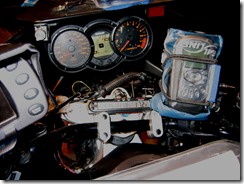 At 4,000 miles, the seat is just beginning to break in. I've tweaked some of the adjustable bits to make the little guy more comfortable for me. At the advice of Jim Winterer, I raised the forks 1/2". That seemed to quicken up the steering slightly. For my tastes, the suspension came set too tight. It's probably just right for sporty motorcycle reviewers, but I'm on this bike for long trips on rough roads. I dropped the rear shock pre-load and lowered the fork preload to the 4th notch. That made the bike's ride squishier and more practical for crappy Minnesota highways and my favorite gravel road surfaces. However, with full touring gear, I cranked up the spring load on both ends to the max.
Maintenance is something Suzuki actually thought about, including a tank prop and a fuel shutoff connector that allows easy removal of the tank for filter and plug changes, valve adjustments, and general motor access. Suzuki should have made a center stand a stock item to complete the serviceability of the bike, but they sell one as an accessory. Most everything you need to get at is accessible with a few standard metric tools by removing a few plastic bits and pulling the seat and tank.
For 2007, Suzuki has updated the WeeStrom's color scheme (gray or blue) and added an ABS brake option. Otherwise, the bike remains mostly the same vehicle that Suzuki introduced in 2004. The 2007 advertised list price is $6999 and $7199 for the ABS model.
Our editor once commented that the most "custom" Harley would be one that is bone stock. I think the V-Strom suffers that same affliction. Browsing the Internet's V-Strom user sites provides a reader with a long litany of items that are "necessary" to make the bike ride-able: crash bars and centerstands, windshields and windshield brackets, suspension modifications, luggage, foot pegs, GPS and cruise-controls and other electronics. The V-Strom seems to be an after-marketeer's wet dream: it's a Harley, a KLR, and a Goldwing all rolled into one accessory-mounting vehicle. I have fallen victim to the "it needs more" trap. My list of "gotta have it" accessories is still growing after a year of ownership.
Other than personal touches, the V-Strom was pretty much ready to ride long distances and rough roads out of the box. I can only say good things about how it held up riding across the western US states, Canada from Saskatchewan to the Northwest Territory, all around Alaska, down to Seattle, and back home on paved, semi-paved, and every non-paved kind of road I've ever imagined. Every day for 26 days and almost 10,000 miles, the V-Strom was problem-free and the most comfortable, dependable bike I've ever owned. The next year, I rode the V-Strom from Minnesota to Nova Scotia and back the longest way I could manage in 26 days. The addition of a Elka rear shock massively improved the handling and road-soaking characteristics. In 2009, I tortured the bike over 2500 miles of North Dakota backroads, including at least 600 miles of dirt roads. The V-Strom inspires confidence in both the machine's capability and reliability. I couldn't be more at home on a bike than I am on my WeeStrom.
Suzuki V-Strom DL650 Accessories
Air FIlter
From my experience, this is a no-brainer. I replaced the stock filter with a K&N. I have had K&N filters in every vehicle I have owned since my 1973 Rickman 125 and my 1973 Toyota Hilux pickup. Call me "superstitious," but I think those filters have added something to the incredible reliability I've experienced in my vehicles. I don't consider a K&N filter an aftermarket "accessory." I think the lack of a K&N filter is simply an incompetent motorcycle design that has to be rectified before the bike is a reliable vehicle.
Hand Guards
 F
F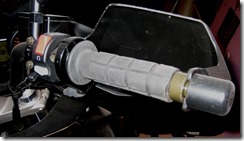 irst up for me was a set of Suzuki hand guards. There are several options for guarding your hands on the V-Strom, but I think the Suzuki solution is the easiest, most practical of the lot. Installation is simple, requires no mangling of the levers or brake reservoir and is easily removed or moved for servicing the brake, grips, and levers. The guards provide decent protection for the levers and excellent wind and flying projectile protection for your hands. They aren't as durable as Acerbis Rally Hand Guards, but the ease of installation and serviceability makes up for some loss in sturdiness.
Center Stand
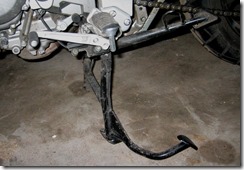 My second necessary add-on was a center stand. Again, I went for the Suzuki stand because of price, quality, and availability. Installation of any aftermarket center stand is a life-threatening exercise and the Suzuki was no exception. All of the bolt-on parts installed easily and precisely, but hooking up the two stand springs was more garage-floor upper-body exercise than I've suffered in a while. Find a good pair of safety glasses before you even think about messing with those springs. If you're going adventure touring, I don't know how you'll survive with a bike this heavy and no center stand. Fixing flats, doing regular maintenance (chain lubes, for example), parking securely with full luggage are all made possible by a center stand. Otherwise, plan on spending a lot of time looking for "just the right rock" in a pinch.
Windshield
 While I wasn't convinced that the V-Strom's windshield was as worthless as some have claimed, I thought it could be better. Apparently, Suzuki does too. Suzuki offers a "tall windshield" (3" taller and 2 1/2" wider than stock) with a plastic wind deflector strip. First, I tried the Madstad bracket, which allows for a variety of height possibilities and a range of angles of deflection. It provided minimal improvement and not enough to make my Shuberth C1 helmet tolerable. So, I added the Suzuki tall shield to the Madstad (madstad.com) bracket. I have the tall shield set on the Madstad's highest setting, angled back as steeply as the bracket will allow. I now have a substantial "calm zone" behind the shield, considerably better weather protection, and a little less wind noise at the helmet. Honestly, when I'm wearing the Shoei X11 I don't notice any difference in noise or turbulence, but it's definitely noticeable when I'm wearing the Schuberth lid.
Pat Walsh Case (Crash) Guards
 Finally, considering my general clumsiness, tendency toward exploring roads that are more technical than my abilities, and the expense of replacing body plastic, I installed Pat Walsh Design's Motor Guard (patwalshdesigns.com), which adds so many features to the V-Strom's frame (additional lights, oil filter guard, skid plate, highway pegs, etc) that a whole new industry of customization options becomes practical. If this thing came in chrome, Mr. Walsh would sell more Motor Guards than Suzuki sold V-Stroms. I've never used highway pegs, but I'm tempted now that I have a place to install them.
W hen I was looking into frame and plastic protection, I almost blew off the Motor Guard because it looked so massive, so I was surprised and happy, when the box arrived, to find that the shipping package was so light. It seems to be a lot of protection for a little additional weight.
Installation was fairly painless, considering the garage floor was about 10oF when I installed the Motor Guard. The whole installation took about an hour and a half, including Locktite'ing every bolt and screw I was near during the installation. The all stainless steel hardware was a surprise bonus and the actual Motor Guard is heavy steel construction securely bolting to the DL's frame at the top and the front of the skid plate at the bottom. The skid plate is equally well secured The screened filter and oil cooler guard is additional gravel protection, but it may be a problem when the front tire fills the screen with mud.
Immediately after installing the Motor Guard, I carefully lowered the bike into the crash position in my driveway. The bike lies resting on the guard, barely past the plastic bodywork, and the handlebar ends. Motor Guards wouldn't save the bodywork in a high speed crash, but in a typical low-speed, off-road spill you might avoid having to replace a few hundred dollars in plastic. Getting the bike back up again takes all the leg strength I own and the Motor Guard gave me a wonderful handle for lifting the bike back onto the kickstand.
Afterward: My long term experience with the Walsh design has been complicated. Not long after installation, I spent a weekend at the MN-Sportbike group's Hedonistic-Enthusiasm cornering seminar. I found that the first sign of lost cornering clearance was when the bottom of the case guard touch ground, lifting the front wheel and putting the bike into a really hard to recover slide on the metal rails. I've since ground about 1/2 of the lowest section of the guard away on both sides.
Seven thousand miles later and about 100 miles north of the Artic Circle, I really tested the crash guards with a crash. On the Dempster Highway, after a 350 mile day and a few dozen miles short of my destination (Fort McPherson, Northwest Territories), I found myself blown backwards on deep gravel. Somewhere between 45 and 55mph, the V-Strom hit the ground pointed exactly backwards from the direction we'd been traveling. The right side case guard took a beating, almost all of the paint was rashed off as the bike slid 50 feet down the road on its side. In the end, I lost the right turn signal, pulverized my right side case, bent my handlebars slightly, gouged up the right side tank panel, and banged up myself pretty well. A little duct tape on the turn signal and the side case and I was on my way back to Dawson City. The case guard and bashplate protected my bike from experiencing any serious damage. The case guard was pretty chewed up on the right side and the bashplate had started to collapse on itself, approaching the front of the exhaust pipe.
For my riding purposes, the biggest advantage provided by Walsh's design over the competition is the bashplate. The V-Strom's low, unprotected pipe and oil filter makes me nervous off pavement. I've already drilled a hole through an SV's oil filter on a long gravel road stretch and I expect to be doing a lot more of that kind of riding on the V-Strom. The bashplate is "secured" to the frame at the rear engine mounting bolts. Otherwise, the plate and crashguards are one structure. A run-in with some deep ruts in North Dakota caused the bashplate to collapse hard against the exhaust pipe. I'm sure that the plate protected the engine, but I need to do some serious metal work to put it all right again.
In trying to repair the plate, I "discovered" it is aluminum. I discovered that by burning a hole in it while trying to make repairs. I'm about 3/4 convinced that the lost cornering clearance makes this product more dangerous than helpful. I may be at the end of my test of the Walsh guards.
IMS Super Stock Foot Pegs (Part # 273116)
 I
I t took me a long time to figure out where to find these pegs. Nobody seems to make an off-road peg for the V-Strom. Fortunately, Suzuki and Kawasaki accidentally got together and made mounts that accept the same peg. Really fortunately, that foot peg is for the Kawasaki KLR650, one of the most common dual purpose bikes in history. In the package, they look a little large, but on the bike they provide an insanely solid platform for long range riding and for off-road grunge or hung-out cornering. After a week riding with the IMS pegs on my V-Strom, I couldn't imagine going back to the stock junk.
Stebel Nautilus Compact Dual-Tone 12-Volt Motorcycle Air Horn
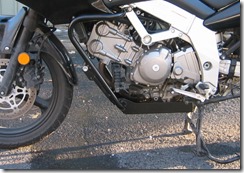 The Stebel Nautilus horn is billed as a 139dB device, which doesn't mean a lot in the real world. For starters, it would be helpful to know where that 139dB is measured. At 1m directly to the side of the vehicle, I measured the output of my horn at 119dB, which is loud but a good distance from 139dB (subjectively, 119 would probably be sensed as about 1/4 of the acoustic "loudness" of 139dB). Since sound pressure drops 6dB for every doubling of distance, the output of a horn becomes pretty mild at practical distances. With the typical noises available in moderate traffic, a horn is only a useful warning device at very near distances. There are contradicting opinions to this evaluation, but they have a financial vested interest.
Pat Hahn and I did some subjective tests and objective measurements when I installed this horn on my V-Strom to see what value a horn (or other noise sources, you loud pipes douchebags) added to a motorcycle's conspicuity. The results were depressing. (Unfortunately, the audio files linked on the Minnesota state's webpage only work with Microsoft's Explorer program.)
Installation is a bit of a pain. Since the horn draws nearly 15A inrush current, you'll need a horn relay. Wiring the horn to your original horn harness will result in a burned-out horn switch. 15A is 4-8X the inrush current of a typical bike horn. Don't skip on the in-line fuse installation, either. A short in that wiring could result in a bike fire, which will definitely draw attention to your motorcycle but that probably won't be all that helpful.
However, the Stebel horn is a bit louder than the stock horn. The pitch of the dual-tone horn is lower and larger sounding, which might convince a braindead cager to give a motorcyclist a glance before violating right-of-way. Anything might help in a crisis. Unless you are right on top of the cage, don't expect the loudest horn to save your ass.


 JANDD Mountaineering Luggage Rack Bag


